
Home / Birth Control / Birth Control Patch
Birth Control Patch Guide
The Birth Control Patch: How It Works, How to Use It and Side Effects
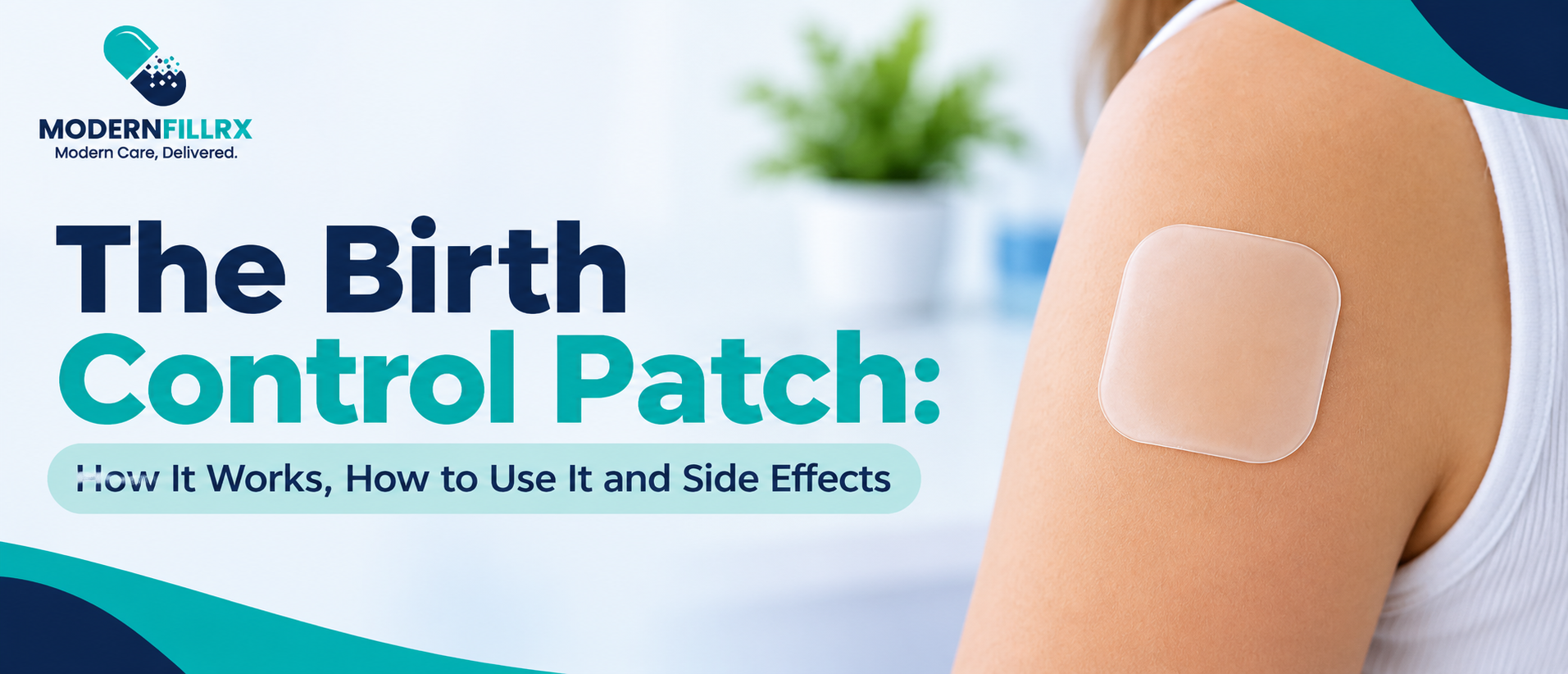
The birth control patch is a thin, square patch you wear on your skin to prevent pregnancy. It releases estrogen and a progestin into your bloodstream every day, and it is a weekly form of hormonal birth control.
You wear each patch for one week, change it on the same day for three weeks, then take a patch-free week. Because you only think about it once a week, the patch suits women who find a daily pill hard to remember.
Key facts at a glance:
- Applied once a week for three weeks, followed by a patch-free week
- Over 99% effective with perfect use, and about 93% effective with typical use
- Releases 150 mcg of norelgestromin and 35 mcg of ethinyl estradiol each day
- Works on the buttock, belly, upper outer arm or upper back
- Needs a prescription, and generic versions of Xulane are available in New York
This guide explains how the patch works, where to put it, how to start and what to do if it falls off. It also covers effectiveness, side effects, safety rules, costs and how the patch compares with other methods.
Birth control online in New York
Get your birth control prescribed by a New York provider
Choose the pill, the patch or the ring, with a monthly or 3-month refill plan and discreet delivery.
Starting at$14.99a month
What Is the Birth Control Patch?
The birth control patch is a transdermal contraceptive, which means it delivers hormones through your skin instead of your stomach. Each patch is about the size of a matchbook and has three layers: a protective backing, an adhesive with the hormones and a clear liner.
The first patch, Ortho Evra, was approved by the FDA in 2001 and is no longer sold. Today, Xulane and Zafemy are the main brands, and generic norelgestromin and ethinyl estradiol patches use the same hormones and doses.
What Hormones Are in the Patch?
Every patch contains a progestin called norelgestromin and an estrogen called ethinyl estradiol, the same estrogen found in most pills. Understanding estrogen vs progestin helps explain why the patch causes some side effects and why it is not safe for everyone.
| Hormone | Type | Released each day |
|---|---|---|
| Norelgestromin | Progestin | 150 mcg |
| Ethinyl estradiol | Estrogen | 35 mcg |
Swipe sideways to see the full table.
These doses are the same in the norelgestromin and ethinyl estradiol patch, Xulane and Zafemy, because they share one FDA-approved formula.
How Does the Birth Control Patch Work?
The patch prevents pregnancy in the same three ways as combination pills, and stopping ovulation is the most important one. Its hormones pass through your skin into your bloodstream at a steady rate, which keeps levels even for the whole week.
- 1
Stops ovulation
the hormones signal your brain not to release an egg from the ovaries.
- 2
Thickens cervical mucus
thicker mucus makes it harder for sperm to enter the uterus.
- 3
Thins the uterine lining
a thinner lining makes it less likely that a fertilized egg could implant.
Why Does the Patch Deliver More Estrogen?
Because the hormones bypass your liver, your body is exposed to about 60% more estrogen overall than with a typical pill containing 35 mcg. This higher exposure is why the patch carries a boxed warning and may raise the risk of blood clots compared with some pills.
Where Should You Put the Birth Control Patch?
You can place the patch on four areas of the body, and all four work equally well in studies. Choose clean, dry and healthy skin where tight clothing will not rub the edges loose.
| Area | Good to know |
|---|---|
| Buttock | Hidden by clothing and least likely to be rubbed |
| Belly (lower abdomen) | Easy to check, but avoid the waistband line |
| Upper outer arm | Easy to reach, but visible in short sleeves |
| Upper back or upper torso | Stays secure, but never on or near the breasts |
Swipe sideways to see the full table.
Tips for Keeping the Patch in Place
- Apply it to skin with no lotion, cream, oil, powder or makeup
- Press firmly for 10 seconds, then run your fingers around the edges
- Move each new patch to a different spot to avoid irritation
- Check it every day, especially after swimming or exercise
- Never use tape or wraps to hold a loose patch in place
The patch stays on in the shower, bath, pool, hot tub and sauna, so you do not need to remove it for water or exercise.
How Do You Use the Birth Control Patch?
Each patch cycle lasts four weeks, with a new patch every week for three weeks and then a patch-free week. The day you apply your first patch becomes your patch change day, and every new patch goes on that same day.
| Week | What you do | What to expect |
|---|---|---|
| Week 1 | Apply your first patch on your change day | Hormones reach steady levels |
| Week 2 | Remove the old patch and apply a new one on your change day | Steady protection continues |
| Week 3 | Remove the old patch and apply a new one on your change day | Steady protection continues |
| Week 4 | Remove the third patch and wear no patch | Your period usually comes this week |
Swipe sideways to see the full table.
After the patch-free week, apply a new patch on your usual change day, even if you are still bleeding.
How to Apply and Remove a Patch
- 1
Open the pouch
tear it along the edge and peel the patch and liner out together.
- 2
Peel off half the liner
avoid touching the sticky surface with your fingers.
- 3
Apply it to your skin
press the sticky half down, peel off the rest of the liner and press the whole patch.
- 4
Hold it for 10 seconds
firm pressure with your palm helps the edges stick.
- 5
Dispose of old patches safely
fold the used patch in half with the sticky sides together and put it in the trash, not the toilet.
How Do You Start the Birth Control Patch?
You can start the patch on the first day of your period or on the first Sunday after it starts. Your start day decides whether you need a backup method, such as condoms, during the first week.
| Start option | When you apply the first patch | Backup method |
|---|---|---|
| First-day start | On the first day of your period | Not needed |
| Sunday start | On the first Sunday after your period starts | Use for the first 7 days |
| Switching from a combination pill | On the first day of your withdrawal bleed | Not needed |
Swipe sideways to see the full table.
Starting the Patch After Pregnancy
If you are not breastfeeding, you can usually start the patch four weeks after giving birth, once your provider confirms it is safe. After a first-trimester miscarriage or abortion, you can usually start within five days without needing a backup method.
What Should You Do If the Patch Falls Off or You Forget to Change It?
The patch only works when it stays fully attached, so what you do next depends on how long it was off. The same applies if you are late changing a patch, where the week of your cycle decides the next step.
If the Patch Comes Loose or Falls Off
| Situation | What to do | Backup method |
|---|---|---|
| Off for less than 1 day | Reapply it if it still sticks, or apply a new patch right away and keep your change day | Not needed |
| Off for more than 1 day, or unsure how long | Apply a new patch now, which starts a new 4-week cycle and a new change day | Use for 7 days |
Swipe sideways to see the full table.
If You Forget to Change Your Patch
| Situation | What to do | Backup method |
|---|---|---|
| Late applying the week 1 patch | Apply a new patch as soon as you remember, which becomes your new change day | Use for 7 days |
| Up to 2 days late in week 2 or 3 | Apply a new patch right away and keep your usual change day | Not needed |
| More than 2 days late in week 2 or 3 | Start a new 4-week cycle with a new patch right away, on a new change day | Use for 7 days |
| Forgot to remove it in week 4 | Take it off as soon as you remember and start the next cycle on your usual change day | Not needed |
Swipe sideways to see the full table.
If you had unprotected sex while a patch was off or late, emergency contraception can lower your chance of pregnancy.
How Effective Is the Birth Control Patch?
The patch is more than 99% effective with perfect use, meaning fewer than 1 in 100 users become pregnant in a year. With typical use, which includes late changes and patches that fall off, about 7 in 100 users become pregnant.
| How the patch is used | Pregnancies per 100 women in a year |
|---|---|
| Perfect use, with every change on time | Fewer than 1 |
| Typical use, including late changes | About 7 |
Swipe sideways to see the full table.
Like every method, birth control effectiveness depends on your routine, but the patch has one extra factor to consider.
Does Body Weight Affect the Patch?
The FDA label says the patch may be less effective in women who weigh 198 pounds (90 kg) or more. If you are in this range, your provider may suggest the pill or the ring instead, because neither has the same weight limit.
What Else Makes the Patch Less Effective?
- A patch that is off for more than one day
- Changing a patch more than two days late
- A patch-free break longer than seven days
- Medicines such as rifampin, some seizure medicines and St. John’s wort
What Are the Side Effects of the Birth Control Patch?
Most patch side effects are mild and fade within the first two to three cycles as your body adjusts. The patch causes the same hormone side effects as combination pills, plus skin reactions where you wear it.
Common Side Effects
- Breast tenderness or swelling
- Headache
- Skin irritation, redness or itching at the patch site
- Nausea
- Spotting between periods, or painful periods
- Mood changes
How Do You Manage Skin Irritation?
Skin reactions are the side effect most specific to the patch, and they usually come from the adhesive sitting on one spot all week. Moving each new patch to a fresh area of skin, and keeping lotions away from it, prevents most irritation.
- Remove an irritating patch and apply a new one to a different spot
- Wear only one patch at a time
- Contact your provider if a rash spreads, blisters or does not settle
Serious Warning Signs
Get emergency care right away if you notice any of these signs, because they can point to a blood clot or stroke.
| Letter | Warning sign |
|---|---|
| A | Severe abdominal pain |
| C | Chest pain or sudden shortness of breath |
| H | A sudden or severe headache |
| E | Eye problems, such as blurred vision or vision loss |
| S | Severe leg pain or swelling, usually in one calf |
Swipe sideways to see the full table.
Most birth control side effects settle with time, and a different method is always an option if they do not.
Who Should Not Use the Birth Control Patch?
The patch carries a boxed warning: cigarette smoking raises the risk of serious heart and blood vessel problems from estrogen methods. Women over 35 who smoke should not use the patch, and the higher estrogen exposure means some other women should avoid it too.
The patch is usually avoided if you:
- Smoke and are over 35
- Have had a blood clot, stroke or heart attack
- Have migraine with aura
- Have high blood pressure that is not controlled
- Have breast cancer now, or had it in the past
- Have liver disease or a liver tumor
- Weigh 198 pounds or more, where it may work less well
- Are breastfeeding, or gave birth in the last four weeks
Your provider checks these risks in your health history, alongside the wider rules on who should not take birth control.
Medicines That Interact With the Patch
| Medicine or supplement | Effect on the patch | What to do |
|---|---|---|
| Rifampin and rifabutin | Lowers protection | Use a backup method during treatment and for 28 days after |
| Some seizure medicines, such as carbamazepine and phenytoin | Lowers protection | Ask your provider about another method |
| St. John’s wort | Lowers protection | Avoid it, or use a backup method |
| Some HIV medicines | Can raise or lower hormone levels | Your provider checks before prescribing |
| Lamotrigine | The patch can lower lamotrigine levels | Your lamotrigine dose may need a review |
Swipe sideways to see the full table.
How Does the Patch Affect Your Period?
Most women get a withdrawal bleed during the patch-free week, when hormone levels drop after the third patch comes off. This bleed is often lighter and more predictable than a natural period, although spotting is common in the first cycles.
Some women use the patch continuously to skip their period, by applying a new patch in week 4 instead of taking a break. Talk to your provider first, because skipping the break increases your estrogen exposure and can cause spotting.
Period changes you may notice:
- Lighter, shorter bleeds during the patch-free week
- Spotting between periods in the first two to three cycles
- Painful periods or cramps for some women
- The option to skip periods with your provider’s advice
Can You Swim, Shower or Exercise With the Patch?
Yes, the patch is designed to stay on during showers, baths, swimming, saunas and hard exercise. Heat, water and sweat do not lower its protection as long as the whole patch stays attached to your skin.
After swimming or a long soak, check the edges and press them down firmly if any part has lifted. If the patch has lost its stickiness, replace it with a new one rather than using tape.
- Do not cut, decorate or alter the patch in any way
- Keep lotions and sunscreen away from the patch area
- The patch does not protect against HIV or other sexually transmitted infections
What Birth Control Patch Brands Are Available?
All birth control patches sold in the United States today share the same basic design, but they do not all contain the same hormones. Xulane, Zafemy and generic patches use one formula, while Twirla uses a different progestin and less estrogen.
| Patch | Hormones | Notes |
|---|---|---|
| Xulane | Norelgestromin and ethinyl estradiol | The best-known brand, a generic of Ortho Evra |
| Zafemy | Norelgestromin and ethinyl estradiol | Same formula and schedule as Xulane |
| Generic norelgestromin and ethinyl estradiol patch | Norelgestromin and ethinyl estradiol | Same formula, often at a lower price |
| Twirla | Levonorgestrel and ethinyl estradiol | Lower estrogen dose, not recommended at a BMI of 30 or more |
| Ortho Evra | Norelgestromin and ethinyl estradiol | The original brand, no longer sold |
Swipe sideways to see the full table.
How Does the Patch Compare With the Pill and the Ring?
The patch, the pill and the vaginal ring use similar hormones and are equally effective with perfect use. They differ mainly in how often you use them, how much estrogen they deliver and how visible they are.
| Feature | Patch | Pill | Ring |
|---|---|---|---|
| How often you use it | Once a week | Every day | Once a month |
| Daily estrogen | 35 mcg, with higher overall exposure | 0 to 35 mcg | 15 mcg |
| Estrogen-free option | No | Yes, the mini-pill | No |
| Visible to others | Yes, on your skin | No | No |
Swipe sideways to see the full table.
These are three of several types of hormonal birth control, and each suits a different routine and health history.
What Are the Pros and Cons of the Birth Control Patch?
The patch works well for many women, but its weekly schedule and higher estrogen dose are not right for everyone. Weighing its strengths against its drawbacks helps you and your provider decide whether it suits you.
| Pros | Cons |
|---|---|
| Only one change a week | Higher estrogen exposure than most pills |
| Easy to check that it is in place | Can be seen on the skin |
| Still works if you vomit or have diarrhea | Can cause skin irritation |
| Can make periods lighter and more regular | May work less well at 198 pounds or more |
| Quickly reversible after you stop | No estrogen-free version |
Swipe sideways to see the full table.
How Much Does the Birth Control Patch Cost?
Without insurance, brand-name Xulane averages about $259 for a box of three patches at retail pharmacies, according to SingleCare. Most New York insurance plans cover the patch with no copay, so check your plan before paying cash.
| Generic patch option at ModernFillRx | Price |
|---|---|
| One-time purchase | $89.99 |
| Monthly refill | $84.99 a month |
| 3-month refill | $249.99 |
Swipe sideways to see the full table.
All three options are available through the birth control patch online service, where a New York licensed provider reviews your health intake.
How Do You Stop Using the Birth Control Patch?
You can stop the patch at any time by taking it off, although finishing your cycle helps you predict your next bleed. Your natural cycle usually returns within one to three months, and fertility can return within weeks of your last patch.
- Your first few periods may be irregular
- Start another method right away if you do not want to get pregnant
- To switch methods, start the new one on the day you would have applied your next patch
Frequently Asked Questions About the Birth Control Patch
Can the Patch Fall Off in the Shower?
The patch is designed to stay on in the shower, bath and pool, and few patches come off completely. Check the edges after water, and follow the fall-off steps above if it comes loose.
Does the Birth Control Patch Cause Weight Gain?
Studies have not shown that the patch causes lasting weight gain in most women who use it. Small early changes are usually fluid retention, which tends to settle within a few months.
Can You Put the Patch on Your Breast?
No, the FDA label says the patch should never be placed on or near your breasts. Use your buttock, belly, upper outer arm or upper back instead, and rotate between them.
Can You Skip Your Period With the Patch?
Yes, some women apply a new patch in week 4 instead of taking a patch-free week. Ask your provider first, because this raises your estrogen exposure and often causes spotting at the start.
How Long Does the Patch Take to Work?
If you apply your first patch on the first day of your period, it protects you right away. With a Sunday start, use a backup method such as condoms for the first 7 days.
Can You Use the Patch While Breastfeeding?
The FDA label does not recommend the patch while breastfeeding, because estrogen can reduce milk supply. A progestin-only pill such as Heather is usually a better option during this time.
Can You Wear Two Patches at Once?
No, you should only ever wear one patch at a time, even when changing to a new spot. If a patch irritates your skin, remove it before you apply a new one somewhere else.
Does the Patch Protect Against STIs?
No, the birth control patch does not protect against HIV or any other sexually transmitted infection. Use condoms alongside the patch every time you also want protection from sexually transmitted infections.
Medical Review and Sources
Medical review: Reviewed by a licensed pharmacist against the FDA-approved label for the norelgestromin and ethinyl estradiol transdermal system and CDC contraception guidance. This guide does not replace advice from your provider.
Sources:
- Xulane (norelgestromin and ethinyl estradiol transdermal system) prescribing information, via DailyMed
- Centers for Disease Control and Prevention (CDC), U.S. Selected Practice Recommendations for Contraceptive Use
- CDC, U.S. Medical Eligibility Criteria for Contraceptive Use
- CDC, contraceptive effectiveness data
- American College of Obstetricians and Gynecologists (ACOG), patient guidance on the birth control patch
- SingleCare, Xulane retail price data
Get Birth Control Online in New York
Start your online visit, and a New York licensed provider will review your health intake before prescribing.